
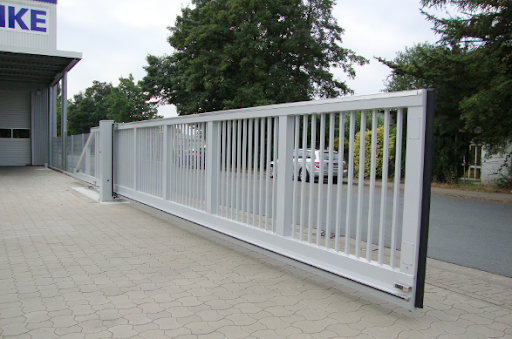
If you’re searching for commercial gates in Melbourne — whether that’s an automatic sliding gate for a warehouse entrance, a swing gate for a retail car park, or a heavy-duty security gate for an industrial site — you’re in the right place. Melbourne businesses, strata managers, and property developers consistently face the same challenge: finding gates that are genuinely built to last in Victoria’s unpredictable climate, meet Australian safety standards, look professional, and can be automated for seamless daily access control.
What Types of Commercial Gates Are Available in Melbourne?
Not all commercial gates are the same — and the right choice depends heavily on your site layout, security requirements, vehicle traffic volume, and aesthetic brief. Here’s a practical breakdown of the main types used across Melbourne commercial and industrial properties.
Automatic Sliding Gates
Automatic sliding gates are the most popular choice for commercial properties in Melbourne. They slide parallel to the fence line, which means they require no swing clearance in front of the gate — critical for tight driveways, busy roads, or sites where vehicles stop close to the entry point. They handle heavy daily use with ease, scale well to wide commercial openings, and work with virtually every automation system on the market.
Sliding gates are commonly specified for warehouses, logistics facilities, schools, apartment complexes, retail centres, and any site where vehicle throughput is a priority. They can be fabricated in steel, aluminium, or Colorbond-compatible profiles to suit the property’s aesthetic.
Automatic Swing Gates
Swing gates operate like a large door — they pivot open from one or both sides. They suit wider driveways where there’s room for the gate’s arc, and they’re often chosen for architectural reasons: a pair of swing gates at a commercial entrance can create a prestige first impression that a sliding gate simply doesn’t match. Many heritage-sensitive Melbourne inner-suburb properties favour swing gates for this reason.
Dual-leaf swing gates are standard for commercial applications. They’re available in steel, aluminium, and timber infill options. Automation is straightforward and reliable with modern underground or surface-mount linear actuators.
Cantilever Sliding Gates
A cantilever gate is a type of sliding gate that doesn’t rely on a bottom track — it’s supported by rollers mounted on a post and “floats” above the ground. This makes them the preferred option for sites with uneven ground, sloped driveways, heavy frost risk, or areas where a bottom track would collect debris and be difficult to maintain. Many Melbourne industrial sites prefer cantilever systems for exactly these reasons.
Telescopic Sliding Gates
Where a site has a wide entry but limited space to slide the gate to one side, a telescopic gate uses two or more interlocking panels that stack into a compact run when open. They’re an engineering-forward solution for constrained commercial sites — popular in densely built Melbourne suburbs where property boundaries leave little lateral space.
Bi-Folding Gates
Bi-folding gates fold back on themselves, opening very quickly with a minimal footprint. They’re particularly well-suited to high-traffic commercial entries — petrol stations, parking structures, and drive-through facilities — where speed of access and minimal cycle time matter. Their faster operation also makes them ideal for properties that need to move high volumes of vehicles per hour.
Choosing the Right Material for Melbourne’s Climate
Melbourne’s weather is famously variable — temperature swings from summer heat above 40°C to cold, wet winters, with coastal winds and UV exposure that are genuinely harsh on outdoor metalwork. The material you choose for your commercial gate needs to perform across all of it without deteriorating, warping, or losing structural integrity.
Heavy-Duty Steel Gates (Palisade or Chainmesh)
Heavy-duty steel gates are the backbone of commercial and industrial gate fabrication in Melbourne. Steel offers unmatched tensile strength, making it the right call for high-security applications, large-span openings, and any site where a gate might face vehicle impact or forced entry attempts. Hot-dip galvanising followed by a powder coat finish is the gold standard for corrosion resistance and longevity in Melbourne’s environment.
RHS (rectangular hollow section) and SHS (square hollow section) steel profiles are most commonly used in commercial gate fabrication, providing the structural rigidity required for large automated gates without excessive weight.
Aluminium Gates
Aluminium gates are significantly lighter than steel — roughly one-third the weight — which reduces wear on automation hardware, lowers structural load on posts, and makes them faster to open and close. Aluminium doesn’t rust, which makes it particularly well-suited to Melbourne’s inner-bay suburbs and coastal-adjacent locations where salt air is a genuine corrosion concern.
Aluminium side gates are also popular for residential and light commercial applications — clean in appearance, low in maintenance, and available in powder-coated finishes to match virtually any property colour scheme.
Colorbond Steel Gates
Colorbond steel side gates integrate naturally with Colorbond fencing panels — giving commercial and light industrial properties a unified, finished look without visible profile mismatches. BlueScope’s Colorbond steel is pre-painted with a thermally cured coating rated for Australian conditions, including Melbourne’s UV load and temperature cycling. Colorbond side gates are a practical, cost-effective solution for commercial side access points.
Timber and Composite Infill Gates
For commercial properties where aesthetics are a primary brief — boutique developments, hospitality venues, prestige residential buildings — timber or composite infill panels within a structural steel or aluminium frame offer warmth and character that metal alone can’t provide. Wooden commercial gates work best in sheltered or semi-covered positions where UV and moisture exposure is managed. Hardwoods like spotted gum or merbau are common choices for Melbourne commercial applications given their proven durability.
Gate Automation Melbourne: What It Actually Involves
Gate automation in Melbourne is far more than bolting a motor onto a gate. A properly specified automation system includes a motor or actuator, a control board, an access control interface (remote, keypad, intercom, loop detector, or app), safety sensors, and a reliable power source — with battery backup in many commercial installations to ensure the gate continues to operate during power outages.
How Does a Gate Automation System Work?
The control board sits at the heart of every system, receiving signals from access devices — a remote fob, a proximity card reader, a vehicle loop detector embedded in the driveway, or an intercom connected to an office or reception area. When an authorised trigger is received, the controller activates the motor, which drives the gate open via a rack-and-pinion drive (for sliding gates) or a linear actuator (for swing gates). Safety edges and photocells detect obstructions in the gate’s path and halt or reverse movement automatically — a core requirement under Australian Standard AS/NZS 60335.2.103.
Access Control Options for Commercial Gates
Modern commercial gate automation in Melbourne increasingly integrates with broader building management and security systems. Common access control methods include:
- Remote controls: Standard for smaller commercial sites and residential applications. Multi-channel remotes allow different access levels.
- Keypads & PIN entry: Simple, audit-free access suitable for low-security commercial entries where staff changes are frequent.
- Proximity card and fob readers: Industry-standard for offices, schools, and any site requiring tracked, auditable access logs.
- Intercom and video intercom systems: Allow remote screening of visitors — standard for apartment complexes, medical facilities, and secure commercial premises.
- Vehicle loop detectors: Embedded in the driveway surface, these detect vehicle presence and can trigger exit-only opening without requiring the driver to use a remote.
- Smartphone app integration: Increasingly common in 2025, allowing gate control via iOS or Android app with remote monitoring capability.
- LPR (Licence Plate Recognition): High-end commercial systems use camera-based vehicle recognition to allow registered vehicles through automatically.
Safety Standards for Automatic Gates in Australia
Any automatic vehicle gate installed at a commercial property in Melbourne must adhere to strict Australian consumer safety laws and hazard reduction guidelines. The core mandatory standard governing automated vehicle gate drives and motor mechanisms is AS/NZS 60335.2.103 . This standard sets out strict compliance requirements for electrical safety, entrapment prevention, maximum operational force limits, and manual emergency release mechanisms.
Compliance is both a legal and an insurance requirement for Victorian business owners. To meet these safety thresholds, commercial installations must feature active obstacle detection systems, including mandatory photoelectric safety beams or physical safety edges on all closing profiles. Always ensure your installer is fully compliant with AS/NZS 60335.2.103
and the relevant provisions of the National Construction Code (NCC). Your local Melbourne council may also enforce specific boundary clearance requirements under local planning schemes.
Real Questions Melbourne Property Owners Ask
Can I buy electric gates at Bunnings?
Bunnings stocks basic gate hardware — hinges, latches, manual gate kits — but it does not supply commercially fabricated electric or automated gate systems. The automation brands available through mass retail are typically rated for very light residential duty, with duty cycles and motor torque ratings that make them unsuitable for commercial environments. A gate that cycles hundreds of times per week under Melbourne conditions needs hardware specified accordingly. Commercial-grade automation systems — from brands like FAAC, BFT, CAME, and Centurion — are supplied and installed by specialist gate fabricators and integrators, not hardware retailers.
What’s the difference between a security gate and a regular commercial gate?
The term “security gate” refers to gates designed with breach resistance as a primary design criterion — heavier steel sections, anti-lift devices, anti-climb profiles, minimal toe-holds, and in some cases anti-ram features. Regular commercial gates prioritise access control and aesthetics but may not be engineered against forced entry. For Melbourne sites with genuine security concerns — warehouses holding high-value stock, logistics facilities, utilities infrastructure — a specifically rated security gate fabricated with appropriate steel section sizes is the right specification.
Are sliding gates or swing gates better for a commercial driveway in Melbourne?
For most Melbourne commercial properties, sliding gates are the practical default. They don’t require the gate to swing into the path of approaching vehicles or pedestrians, they work on sloped driveways (with the right system), and they’re available in spans wide enough for B-double truck access if needed. Swing gates make sense when you have a generous, flat driveway, want a prestige aesthetic, or have a specific architectural reason to prefer them. Both can be fully automated to the same performance and safety standard — the choice comes down to site layout and brief.
Do I need a planning permit to install a commercial gate in Melbourne?
This varies by council, zone, overlay, and gate height. In Victoria, planning permits for gates and fencing are governed by the relevant local planning scheme and the Planning and Environment Act 1987. As a general guide, commercial gates above 2 metres in height, or those on a road-facing boundary in a sensitive zone, are more likely to require a permit. Your gate installer should be familiar with local requirements, but the safest approach is always to check directly with your council’s planning department before work begins. The Victorian Planning Authority’s website provides useful background on planning zones and overlay requirements.
What is the best commercial gate installation approach for a high-traffic Melbourne site?
For genuinely high-traffic commercial gates — sites cycling 200 or more operations per day — the specification checklist looks like this: heavy-duty commercial-rated motor with appropriate duty cycle (typically industrial-rated, not standard commercial), robust steel or aluminium construction with reinforced hinge and drive points, photocell safety beams, a secondary safety edge, vehicle loop detectors for exit-only automated opening, reliable battery backup, and a preventive maintenance schedule. Getting any one of these elements wrong on a high-traffic site leads to expensive downtime, safety incidents, or both. This is the environment where a fully custom-fabricated gate — not an off-the-shelf product — earns its value.
What automatic gate options are available for specific Melbourne suburbs?
SF Fencing installs automatic gates across all of greater Melbourne. Commonly requested areas include automatic gates in Bentleigh, Templestowe, and Essendon — each with its own local planning context, typical property styles, and access challenges. Inner-east suburbs often require slimmer gate profiles to suit narrow side accesses; outer eastern suburbs like Templestowe typically accommodate larger gate openings with more space for automation hardware. A local installer who knows Melbourne’s suburbs understands these nuances without being told.
Driveway Gates Melbourne: Commercial vs. Residential Crossover
The line between commercial and residential gate requirements increasingly blurs in Melbourne’s mixed-use inner suburbs. A block of apartments is technically a residential building but shares access control and security requirements with many commercial properties. A boutique warehouse conversion in Fitzroy North has an industrial heritage but a residential-grade usage pattern. A medical practice on a commercial strip needs after-hours security but low daily access volume.
Driveway gates in Melbourne work across all these contexts — and the best fabricators understand how to spec a gate that answers both the practical and aesthetic brief regardless of where the property falls on the commercial-residential spectrum.
What distinguishes a properly specified driveway gate for a Melbourne apartment complex or mixed-use development versus a basic residential gate comes down to a few things: motor duty cycle to handle multi-resident daily access, intercom integration for visitor screening, battery backup for common-area safety compliance, and a finish that remains presentable without constant maintenance under Melbourne’s sun, rain, and UV exposure.
Custom Gates and Fencing Melbourne: Why Off-the-Shelf Often Falls Short
Melbourne’s property stock is diverse — Federation homes in Essendon, post-war industrial buildings in Sunshine, contemporary mixed-use in Docklands, sprawling commercial properties in Dandenong South. No catalogue gate fits all of these. That’s why custom gate fabrication remains central to quality commercial gate installation in Melbourne.
A custom-fabricated gate is designed around your specific opening width, post positions, ground level, automation requirements, and design brief. It means the steel section sizes are right for the span, the automation hardware is matched to the gate weight and duty cycle, and the finish is specified for your site’s exposure conditions. Off-the-shelf gates frequently require compromises on all of these dimensions — a 4-metre gate kit designed for a 3.5-metre opening is a structural and aesthetic problem that compounds over time.
SF Fencing Melbourne fabricates commercial gates from scratch for exactly this reason — every project is measured, designed, and built to the site. The result is a gate that fits, operates reliably, and lasts significantly longer than any catalogue alternative.
Side Gates Melbourne: Aluminium, Colorbond & Steel Options
Side access gates are a practical necessity on almost every commercial property in Melbourne — they control pedestrian access, secure service entries, and provide a secondary access point without requiring the main vehicle gate to be opened. The three most commonly specified materials for commercial side gates in Melbourne are:
- Aluminium side gates: Lightweight, rust-proof, low maintenance, and available in a wide colour range via powder coating. The preferred choice for most modern commercial properties in Melbourne.
- Colorbond steel side gates: Integrate seamlessly with existing Colorbond fencing. Durable, low maintenance, available in the full BlueScope Colorbond palette.
- Steel side gates: Maximum strength and security for higher-risk access points. Heavier than aluminium, but the right call where strength is the priority.
Hardware quality matters as much as material choice for commercial side gates. Heavy-duty stainless steel or galvanised hinges, self-closing mechanisms, robust locking systems, and proper ground clearance on sloped or uneven approaches are all details that separate a gate that works properly long-term from one that sags, drags, or fails within a few years.
Electric Gates Melbourne: What Makes a System Genuinely Reliable?
Electric gates in Melbourne — whether sliding, swing, or bi-folding — are only as good as the automation system behind them. A beautifully fabricated gate fitted with an undersized motor, inadequate safety hardware, or a poorly installed control board will fail prematurely and create liability exposure. Here’s what actually separates a reliable electric gate system from one that looks good until it doesn’t.
Motor Duty Cycle
Every gate motor is rated for a specific duty cycle — the percentage of on-time versus off-time it can sustain without overheating. Residential-grade motors are typically rated at 30–50% duty cycle. Commercial installations require motors rated at 80–100% duty cycle, also described as “continuous duty.” Using an undersized motor on a commercial site is one of the most common — and most expensive — errors in gate installation.
Safety Hardware
Under AS/NZS 60335.2.103, commercial automatic gates must incorporate safety devices to prevent entrapment. At minimum, this means photocell beams across the gate path and a safety edge (pressure-sensitive contact strip) on the leading edge of the gate. On high-traffic commercial sites, additional loop detectors, presence sensors, and warning lights are standard specification.
Battery Backup
Melbourne’s weather occasionally delivers mains power outages — and a commercial gate that locks shut during a power outage is both a safety hazard and an operational crisis. Battery backup systems allow the gate to complete its current cycle and perform a defined number of additional operations on stored power. For commercial properties, battery backup is not optional — it’s a basic specification requirement.
Preventive Maintenance
Even the best-specified commercial gate system needs regular servicing — drive chain or rack lubrication, safety device testing, limit switch calibration, battery health checks, and hardware inspection. A gate serviced on schedule performs predictably and has a substantially longer service life than one run to failure. Ask your installer about a maintenance schedule at the time of installation, not after the first breakdown.
Victorian Commercial Gates & Fencing: The Local Regulatory Picture
Getting a commercial gate project right in Victoria requires understanding a regulatory framework that sits across planning, building, and Australian Standards simultaneously. Here’s a practical overview:
- Victorian Planning Schemes: Gate and fence height, design, and positioning are regulated at the municipal level under local planning schemes. Heritage overlays, design and development overlays, and environmental overlays can all impose additional requirements on commercial gate installations. Always check with your council’s planning department before proceeding.
- National Construction Code (NCC): The NCC sets out building performance requirements that apply to structures including fences and gates in commercial contexts. Relevant provisions relate to structural adequacy, durability, and safety.
- AS/NZS 60335.2.103 : This Australian Standard is the primary safety reference for automatic gate installations. Compliance is a legal requirement on commercial properties and an insurance prerequisite for most commercial and industrial sites.
- WorkSafe Victoria: On commercial and industrial sites, powered gate systems that expose workers to risk may also fall within WorkSafe Victoria’s jurisdiction. Duty of care obligations under the Occupational Health and Safety Act 2004 (Victoria) require that powered equipment — including automated gates — is safe for those who use or work near it.
SF Fencing Melbourne installs commercial gates that meet all applicable Victorian regulatory requirements as standard. We don’t leave compliance as an afterthought — it’s built into every project from the design phase.
Why Melbourne Businesses Choose SF Fencing for Commercial Gate Installation
There’s a significant difference between a company that sells and installs prefabricated gate kits and a fabricator that designs, builds, and installs gates from raw steel and aluminium. SF Fencing Melbourne is the latter. Every commercial gate project starts with a site assessment, proceeds through a design and engineering phase, moves to in-house fabrication, and culminates in professional installation — with a single team accountable for every step.
Custom Fabrication
Every gate is designed and built to your site’s exact specifications — no off-the-shelf compromises.
Full Automation Integration
Gate fabrication and automation handled as one seamless project — no handoff between trades.
Melbourne-Wide Service
Covering all Melbourne suburbs from Bentleigh to Templestowe, Essendon to the outer east and south.
Compliance Ready
All automatic gate installations meet AS/NZS 60335.2.103 and Victorian regulatory requirements as standard.
Material Expertise
Steel, aluminium, Colorbond, and timber — specified for Melbourne’s climate, not just aesthetics.
On-Time Delivery
Punctuality and deadline commitment built into every project — as our clients confirm.
What Melbourne Clients Say About SF Fencing
“I really appreciate SF Gates and Fencing team that they have done beyond amazing work of automatic gate and front fence for my new apartment. The team is highly professional, dedicated, punctual, and friendly. They are cost effective, yet provide the best quality work I have ever seen and they are committed to finish the work by deadline. Highly recommended.”
— Jasbel Zaz
“Positive: Responsiveness, Punctuality, Quality, Professionalism, Value”
— Sohaib